By Dave Elliot
For one full year, I had researched reviews from other motorcyclists who had traveled Route 389 from Baie-Comeau to Labrador City, and from Labrador City to Blanc-Sablon, followed by the ferry crossing to St. Barbe, Newfoundland. I had read the warnings, studied the maps, examined photographs, memorized the locations of fuel stops, and listened carefully to stories from riders who had gone before me. I had crossed every T and dotted every I.
But nothing—absolutely nothing—could prepare me for what I was about to encounter.
I had hoped to make the entire 352-mile ride from my overnight stay at Jardin des Glaciers in Baie-Comeau, Quebec, straight through to Labrador City. On paper, it seemed like a long day in the saddle. In reality, it would become one of the most physically and emotionally demanding motorcycle rides of my life.
On Wednesday, July 29, I took one last look at the now permanently closed “Glacier Garden,” famously housed in a repurposed former church building. It was a perfect location for an overnight stay after coming across on the ferry. The old structure stood quietly behind me as I climbed onto my motorcycle and pulled away from the parking lot. There was something almost fitting about leaving a place that had once welcomed travelers and was now silent, its doors permanently closed.
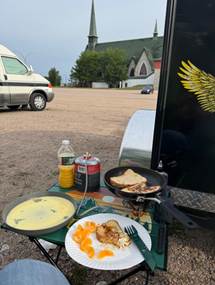
Breakfast at Glacier Garden before departure.
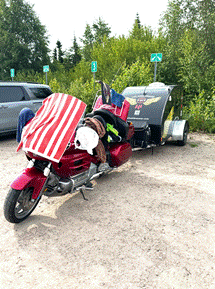
Drying out from the previous day on Gaspe Peninsula.
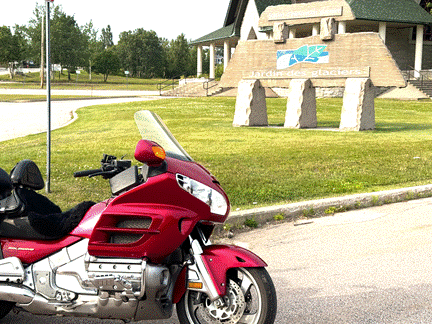
Preparing for departure from Jardins des Glaciers.
I headed northwest down Avenue Denonville. Twelve minutes later, I arrived at an Irving Oil gas station, one of the last major fueling opportunities near the southern gateway of Route 389.
I put 22 liters into the motorcycle’s tank and filled my new Giant Loop five-gallon fuel bladder. I wouldn’t need the extra fuel until Happy Valley-Goose Bay, well beyond Labrador City, but on a road like Route 389, fuel wasn’t something you took for granted. It was insurance.
The sky was a dull, heavy gray. There was no sunlight breaking through the clouds, and the air carried the damp chill that often precedes a long day of rain.
The evening before, I had spoken with a volunteer worker at a local church who was helping with food supplies. He had just traveled south on Route 389 with his family. When I asked him about the road and the weather, he reassured me that I would have no problems. The forecast called for a 90 percent chance of rain, but he told me it would probably amount to nothing more than mist and light rain throughout the day.
Those words would stay in my head for quite some time.
At 9:00 a.m., I left Irving and traveled the half mile along Boulevard Lafleche before turning north onto Route 389.
There was no dramatic gateway. Just one yellow sign in French which translated “Sections blocked off when the lights are flashing.” The sign revealed the seven sequential driving segments. No lights were flashing so I took that as a positive note as I entered one of Canada’s most isolated stretches of highway. Ahead was just pavement disappearing into a wall of trees.
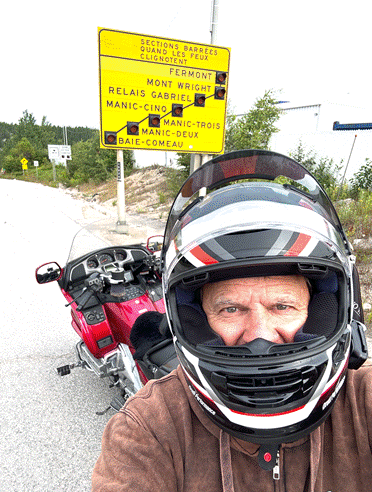
The road seemed to swallow me.
Five miles in, another motorcyclist passed me heading south. Even beneath his helmet, I could almost sense his excitement. His throttle hand had a little extra enthusiasm, and his body language suggested a man who had just accomplished something significant. I waved as he passed.
For the next two hours, I saw only three vehicles.
Then four motorcycles heading toward Baie-Comeau passed me in the opposite direction, and I raised my hand to each one.
The forest closed in again.
When I had chosen Route 389 as part of my 2026, month-long summer journey, I knew I was choosing the road less traveled. That was exactly what attracted me to it. Adventure, for me, has never been about taking the easiest road. It is about seeing places I have never seen before, experiencing something outside the ordinary, and returning home with a story that could not have been written from an armchair.
As soon as I crossed the Campbellton Bridge some five days earlier and headed east along the southernmost portion of the Gaspé Peninsula, I had begun asking nearly everyone I encountered if they had ever ridden Route 389.
Almost no one had.
At an information booth, the attendant could tell me about the peninsula but knew little about the route north. At gas stations, I found people who knew the names of nearby towns but had never traveled the road themselves. Nobody seemed to have a map covering the entire Quebec and Labrador sections of Route 389.
It was beginning to dawn on me just how remote I was about to become.
For the first 132 miles, the road remained paved but paved did not mean easy. The terrain became increasingly hilly, winding and twisty as I moved deeper into the boreal forest. The trees seemed to stretch endlessly in every direction—spruce, fir and other evergreens packed tightly together, their branches forming a green wall that blocked any sense of civilization.
Occasionally, a lake would appear through the trees.
Some were enormous stretches of dark, cold water reflecting the gray sky. Others were smaller and almost perfectly still.
On one particularly isolated stretch, I passed a lake on each side of the road, and each lake had only one house.
One house.
No visible road led to either one.
I couldn’t help wondering about the people who lived there. Why had they chosen such a remote existence? How had they brought in building materials? How did they get food, fuel and supplies?
At one of the homes, a small boat sat tied to a dock. It was the only visible clue.
I imagined lumber, tools, appliances and everything else needed to build a home arriving by water—or perhaps being dragged out of the surrounding forest.
It was a rugged, isolated lifestyle surrounded by wilderness on every side. A tiny fraction of people willingly choose this kind of deep boreal forest and subarctic isolation simply to escape the noise, traffic and crowds of the population centers farther south.
I respected that.
At the same time, I was beginning to understand just how alone I was.
Route 389 offered almost no paved turnoffs. There were virtually no shoulders where a motorcyclist could safely pull over during an emergency. There was no convenient place to stop, rest, or deal with a mechanical problem.
I would soon learn the hard way that, for the remainder of my journey north, stopping would have to be carefully considered.
Shortly after the dam, the road climbed sharply. I slowed the motorcycle and attempted to pull over long enough to photograph a section of forest that had been burned by wildfire.
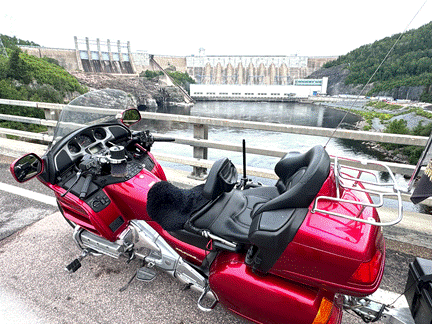
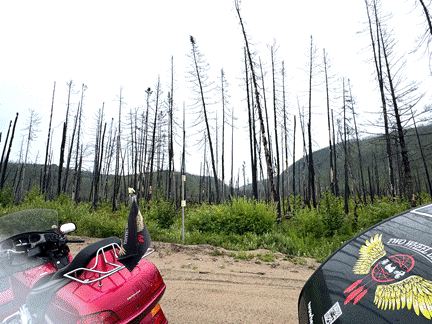
The blackened trees stood like skeletons against the surrounding green.
Smoke from Canadian wildfires had drifted into the northern United States this summer, turning skies hazy hundreds of miles away. Now I was standing beside the source environment itself, looking at the scars left behind by fire.
I could only assume this particular fire had started from lightning. At this elevation, there was little else around to ignite it.
I eased the motorcycle toward the edge of the road.
The moment my front tire touched the shoulder, it disappeared into what I can only describe as motorcycle quicksand.
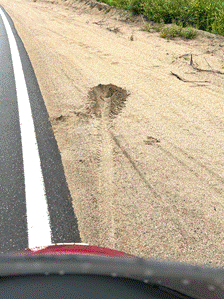
The tire sank and buckled sideways.
The entire motorcycle shifted beneath me.
For a split second, my heart jumped into my throat.
I grabbed the handlebars and fought to keep nearly 900 pounds of motorcycle and gear from falling over. Somehow, I managed to straighten the bike.
That was enough.
I quickly took the photographs I wanted and then put the motorcycle into reverse, carefully backing away from the soft shoulder.
Tow trucks on this road were expensive, and depending upon where you were stranded, they could take hours to arrive.
There was also something else I had to keep reminding myself:
There was no cell service.
None.
For now, however, I was still upright.
I continued north.
The road climbed so steeply that I had to downshift several times before eventually continuing the ascent in first gear. I wanted to stop and photograph the landscape, but the risk was no longer worth it.
Then I noticed the first droplets of rain on my windshield.
One.
Then another.
Within minutes, the windshield was dotted with moisture and the air had become thick with mist.
I hoped it wasn’t the beginning of something worse.
I had not seen a single raindrop since leaving home on July 23. My four nights and five days on the Gaspé Peninsula had been almost perfect—blue skies, orange sunsets and moonlit water shimmering across the Gulf of St. Lawrence.
Now the sky was closing in.
I could feel the temperature dropping.
I looked down at the temperature gauge.
64 degrees.
The rain intensified.
I lifted the clear visor on my helmet just enough to keep it from fogging, allowing the cold, damp air to hit my face. The combination of mist, rain and road spray made visibility increasingly difficult.
Route 389 was about to change from challenging to dangerous.
The route featured winding paved sections followed by long stretches of loose gravel. There were washboard surfaces that could shake the motorcycle violently, potholes deep enough to swallow a tire, narrow winding sections and sharp mountain curves.
There were few places to stop.
Few places to eat.
Few places to get help.
And fewer places to turn around.
I continued wearing my hooded sweatshirt, and for a while the rain wasn’t penetrating it. My cell phone was mounted on the right handlebar, normally my lifeline for directions and fuel locations. But there was no service. Waze had automatically transferred to offline maps, and I knew from experience that offline navigation could be unreliable.
Even my iPod, loaded with enough downloaded music to keep me company for hours, was no longer accessible.
The silence became enormous.
There would be no music.
No phone calls.
No conversation.
Just the motorcycle, the rain, the wind and the forest.
I had expected the ride to Labrador City to take approximately seven and a half to eight hours under good conditions.
These were no longer good conditions.
At Manic-5 Dam, approximately 133 miles into the journey, I reached the transition point.
Ahead of me was gravel.
And beyond that gravel were 62 miles to Relais Gabriel—a critical stop offering the last available gas and food before Fermont, just south of Labrador City.
The rain was now steady.
I had to use the bathroom badly enough that there was no more waiting.
I finally found a relatively straight section of road, pulled the motorcycle as far to the right as I could without allowing the trailer tires to fall into the sand, and climbed off.
I stood facing the motorcycle and the wall of evergreens beyond it.
My left ear was pointed north.
My right ear was pointed south.
I listened.
Nothing.
Then I listened again.
On a road this isolated, you learned to listen before you looked.
I quickly did what I needed to do and put on my rain jacket. My sweatshirt was beginning to absorb the rain. I kept my fingerless riding gloves on, but my fingers and palms were already beginning to wrinkle and redden from the moisture.
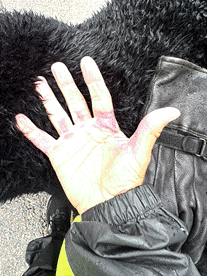
The weather was winning.
But I wasn’t ready to quit.
Manic-5 Dam itself is an enormous structure. The largest multi-arch buttress dam in the world, it stands 214 meters tall and stretches 1,314 meters across the Manicouagan River. The dam powers the region’s hydroelectric generating stations and is one of the most remarkable engineering structures in northern Quebec.
Just a few miles away sat Motel de L’Energie, with a convenience store, fuel and a small restaurant.
I pulled in. The afternoon had arrived and it was 12:28 PM. I had travelled 136 miles since fueling up in Baie-Comeau earlier that morning.
I needed information more than I needed food.
I began asking anyone who might know what lay ahead—store attendants, motorcyclists and truckers. I was looking for someone who had just come south through the unpaved northern sections of Route 389.
But the language barrier kept getting in the way.
Some spoke only French.
Others spoke enough English to communicate, but none had recently traveled the section I was about to enter.
I stood there listening to the rain and staring toward the road.
Should I stay?
Should I roll the dice?
What were the gravel roads like after all this rain?
Would they be passable?
Would my motorcycle make it?
Would the trailer make it?
Would I?
I could pull into the small hotel parking lot, crawl into my trailer and sleep.
But the forecast was calling for rain for the next six days.
Waiting could mean days.
And if the roads were already deteriorating, they weren’t likely to improve while the rain continued to fall.
Time was becoming a factor.
So, I made the decision.
I would continue.
Traveling by motorcycle gives you a freedom that traveling by car, truck or RV simply doesn’t provide. But that freedom comes with something else—a constant series of decisions. Weather, road conditions, fuel, fatigue and mechanical problems can change your plans in an instant.
This was a roll of the dice.
As I would soon discover, no dice roll in this situation was going to come out on top.
I pulled my rain pants over my now-wet jeans.
The rain was steady.
I stared down Route 389.
The road disappeared into the gray.
I had no idea what waited beyond that first hill.
I turned left out of the motel parking lot.
Within minutes, several eighteen-wheelers came toward me.
Their massive tires cut deep into the wet gravel, leaving two-inch tracks behind them. Each truck threw a wall of muddy spray into the air.
The mud struck my windshield.
Visibility disappeared.
There was zero room for error.
I tried to find the driest section of road for my tires, but I wasn’t controlling just two motorcycle tires anymore.
There were two more tires behind me.
The trailer had its own path.
Its own weight.
Its own momentum.
And, in those conditions, it seemed to have its own mind.
At one point, I moved toward the middle of the road because it appeared to offer the best traction.
I was concentrating so intensely on the road ahead that I failed to notice a truck approaching from behind.
Then it happened.
The truck driver laid on his horn.
The sound exploded behind me.
It seemed to last forever.
I jumped.
My heart pounded.
For a moment, fear was replaced by anger.
Didn’t he see what I was dealing with?
Didn’t he understand that I was on a motorcycle, pulling a trailer, trying to keep the bike upright on a road that was barely holding together?
Apparently not.
I did everything I could to move back into the slushy right lane and let him pass.
A few choice words escaped from beneath my helmet.
As the truck went by, I glanced toward the cab.
The driver never even turned his head.
He was gone almost as quickly as he had appeared.
I was alone again.
Except now the road was getting worse.
Another hour had passed and it was now 1:30. I made another stop. Two bikers pulled up behind me asking if I was okay. I later learned their names were Mikey and Alex and that they were computer programmers. They looked to be in their twenties. Both motorcycles were rather antiquated which prompted me to ask what year for their bikes. Both were 1982’s – one a Honda and the other a Suzuki. I was told that the bikes were purchased just for this trip – one for $800 and the other for $200! I wondered if the bikes would make the journey and then countered my own thoughts that their adventure bikes with smaller tires had a better chance of getting through the challenging conditions than my Gold Wing. They offered to stay with me until Relais Gabriel, but I knew my Wing would fall behind. I thanked them, climbed aboard and watched them disappear in my side mirror as I descended the next hill. It didn’t take long for them to pass me by with all of us giving head nods for fear of letting one hand off our handle bars.
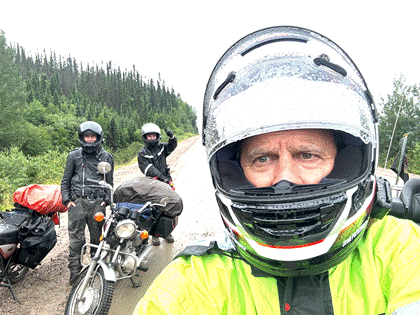
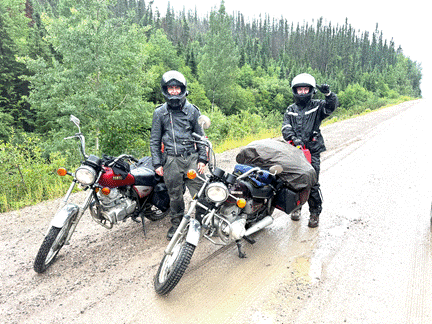
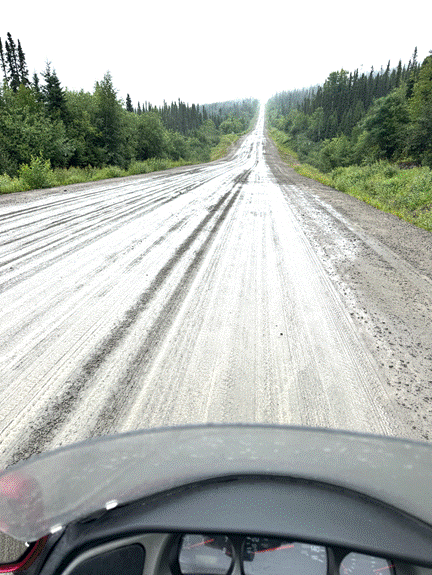
Mud tracks
Moments after stopping to video, my motorcycle began weaving between mud and deep tire tracks.
The trailer started moving independently behind me.
The road rose and fell like a roller coaster. One hill disappeared into the next. The climbs were steep. The descents were equally dangerous.
I could manage only 10 to 15 miles per hour.
It felt as though I was making progress one-tenth of a mile at a time.
Finally, I stopped, again.
I got off the motorcycle.
I looked behind me.
Then ahead.
Rain fell from the brim of my helmet.
The road stretched into the gray wilderness.
I stood there and prayed that the rain gods would somehow guide me through.
I was nearly halfway to Labrador City.
Turning around was still an option.
But it was not an option I wanted.
I thought about my parents.
Mom had passed in 2020.
Dad followed in 2024.
On so many motorcycle journeys throughout my life, I had felt their presence with me. The gold wings mounted on my trailer were my way of honoring them—and, in some small way, believing they were watching over me.
I looked at those wings.
I tried to stay positive.
I told myself I could do this.
Then I prayed.
I climbed back into the saddle.
I gave the motorcycle just a little throttle.
And moved forward.
At approximately 10 miles per hour, the tires suddenly lost traction.
The motorcycle began to slide.
There was no warning.
No time to react.
The bike rolled onto its left side, throwing me off with it.
I hit the mud.
Hard.
For a few seconds, everything went quiet.
The motorcycle’s engine sputtered and then died.
I lay there, motionless, waiting.
Was I hurt?
I moved my arms.
My legs.
My back.
I took a breath.
Nothing.
I was okay.
Then another thought hit me.
Traffic.
I immediately scrambled to my feet and looked in both directions.
Nothing.
But I could see the possibility in my mind.
Another vehicle coming over that hill.
A truck unable to stop.
A driver who didn’t see me.
A collision.
I turned my attention back to the motorcycle.
The trailer had survived.
Now I had to get the motorcycle upright.
The bike weighed approximately 875 pounds dry. With the gear in the luggage rack, the two saddlebags and everything else I was carrying, it was well over 900 pounds.
I grabbed the motorcycle.
Pulled.
Nothing.
My first attempt was futile.
Adrenaline surged through me.
There was no one coming.
No cell service.
No tow truck.
No easy way out.
I bent my knees.
Gathered everything I had.
Leaned backward.
And pulled.
Slowly, painfully, the motorcycle began to rise.
I kept pulling.
Finally, it came upright.
I looked down.
The left foot crash bar was bent.
A piece had broken off and disappeared into the mud.
I found it, picked it up and threw it into the luggage rack.
The rear crash bar had taken most of the impact.
I tried starting the motorcycle.
Nothing.
I waited.
Tried again.
Still nothing.
I knew the engine had probably flooded.
I waited another full minute.
Then turned the key.
The engine finally came back to life.
But I didn’t move.
I simply sat there.
For a man who had spent his entire life rising to challenges, for someone motivated by adversity and by people telling him something couldn’t be done, this was different.
For one of the rare times in my life, I felt defeated.
I climbed off the motorcycle.
I looked at the road.
Then at the rain.
Then at the motorcycle.
What do you do when you have reached the point where you don’t know what to do?
Where do you turn when there seems to be nowhere to turn?
Then, through the rain, I saw a pickup truck approaching.
The driver slowed.
He had seen me.
He could see the mud covering my clothing and motorcycle. More importantly, he could see the look in my eyes.
He stopped.
The driver got out of his truck and immediately began speaking French.
I couldn’t understand a word.
I responded with my hands.
I pointed toward the motorcycle and moved my hands in a weaving motion, mimicking the bike sliding across the road.
Then I shrugged.
The message was simple.
I had fallen.
I was in trouble.
His name was Claude.
Claude offered to tow my trailer in the direction I was traveling, even though he had been heading the opposite way.
I pointed toward his truck and then down the road in the direction he had originally been traveling.
He pulled out his phone and began scrolling.
For what seemed like an eternity, he searched through his photographs.
Then he turned the phone toward me.
It was a photograph of one of his three motorcycles.
I smiled.
A biker.
I immediately felt a connection.
Because over the years I had learned something about motorcyclists:
When a biker is down, other bikers rally.
Claude pointed toward his truck’s hitch.
I pointed toward the direction he had been traveling.
He shook his head.
No worries.
He motioned toward the road ahead.
He was going with me.
We began the difficult process of disconnecting my trailer from the motorcycle.
The hitch was packed with mud.
The electrical wiring was caked in it.
Even the rear-view camera connection was covered.
But together we got it disconnected.
We moved the trailer to his truck.
Then Claude motioned for me to lead.
He would follow.
With my trailer behind him.
I looked down the road.
Then into my rearview mirror.
Claude was waiting.
I took a breath.
Gave the motorcycle some throttle.
And immediately held on for dear life.
The bike slid from the right side of the road all the way toward the left.
Then, like a terrified novice water skier hanging onto a tow rope, I crossed the wake and slid all the way back toward the right.
The motorcycle was fishtailing.
I don’t know how I kept it upright.
But somehow, the bike finally straightened.
I began looking for flat sections of road.
Some were barely wide enough for my tires.
An inch to the left or right could mean another fall.
At times, I rode all the way along the left side of the road, even while climbing uphill, because that was the only place I could find enough stability to remain upright.
As I approached the crest of each hill, I would stand on the motorcycle pegs and look ahead, trying to see whether an eighteen-wheeler was approaching from the other side.
Every hill brought another decision.
Every curve brought another risk.
Every mile felt earned.
My adrenaline was flowing.
Later, I would learn why the road had become so treacherous.
Calcium chloride, usually applied in liquid form, is used on unpaved sections of Route 389 as a dust suppressant and road stabilizer. The chemical is hygroscopic, meaning it attracts and retains moisture from the air.
Under normal circumstances, it helps stabilize the road.
But with all the rain that day, it helped create something entirely different.
A road surface that felt like grease.
We passed an abandoned motorcycle on the right.
I glanced toward it.
It appeared to have been left exactly where it had crashed.
There was no rider.
No person standing nearby.
Nothing.
I wondered what had happened.
Was the rider injured?
Had someone come to rescue them?
Had they simply walked away?
I didn’t know.
About a quarter mile farther, a Suburban had slid off the road in the opposite direction and lodged against a guardrail.
Again, no driver.
No passengers.
No one around.
The two abandoned vehicles stayed with me.
They became warnings.
I had to remain focused.
My windshield was now covered in so much mud that I could barely see through it.
I had to peer over the top inch by inch, lifting myself partially off the seat and riding in a strange crouched, bent-knee position.
Potholes were everywhere.
And where there was a pothole, there was standing water.
Where there was standing water, there was soft mud.
And where there was soft mud, there was danger.
We continued at 15 to 25 miles per hour.
Mile after mile.
Hill after hill.
Curve after curve.
For approximately 30 miles, Claude followed behind me with my trailer in tow.
Then, suddenly, the gravel ended.
Pavement.
Real pavement.
I continued another hundred yards before pulling over.
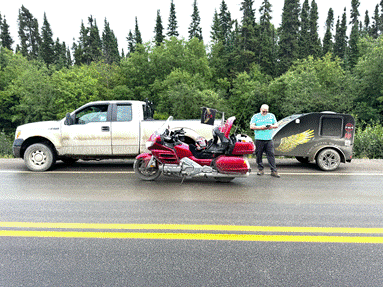
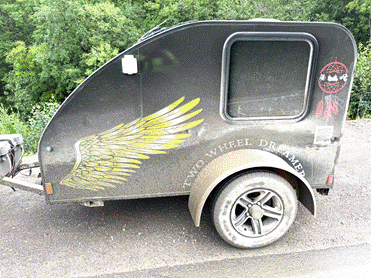
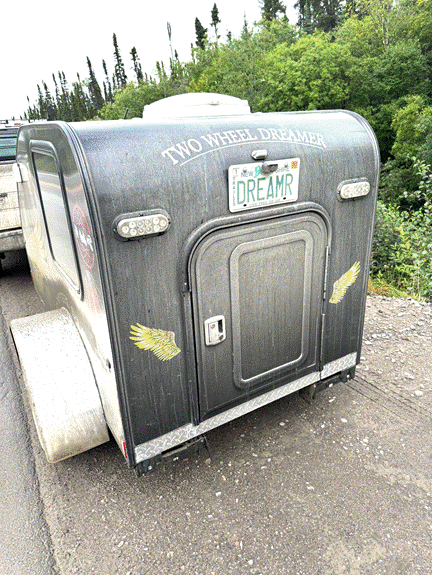
I wasn’t sure I had actually made it.
I stopped the motorcycle.
My hands were shaking.
My entire body was shaking.
I sat there for a moment, trying to process what had just happened.
Then Claude pulled his truck alongside me.
He climbed out.
He looked at me.
And smiled.
He gave me a congratulatory grin and a huge pat on the back.
We had made it.
Together.
We unhooked the trailer from his truck and began washing the mud from the hitch and wiring.
The equipment was almost unrecognizable beneath the thick coating of mud.
When we were finished, I put my hands together in the universal sign of prayer and thanked him as best I could.
Then I pointed toward him.
And then toward one of the gold wings on the front of my trailer.
I hoped he understood.
I was trying to tell him that he had been my guardian angel that day.
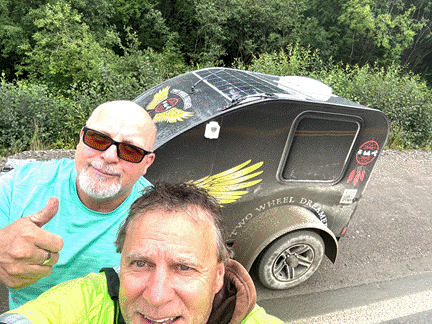
I motioned for him to wait.
I crawled into my camper and returned with an extra-large Two Wheel Dreamer shirt.
I handed it to him.
Claude looked at the tag.
XL.
He laughed.
Then pointed at his stomach.
2XL.
We both laughed.
He tucked the shirt underneath his arm and reached out with his enormous hand.
We shook hands.
Then I started to hug him.
Claude held on.
Long.
Tight.
Not the quick embrace of two strangers saying goodbye, but the kind of hug that says more than words ever could.
He gave me comfort.
I gave him my business card.
Through a combination of hand gestures and broken communication, I learned that his brother spoke English and could interpret a phone call if I needed to reach them.
Claude was still concerned about me.
It was obvious.
This wasn’t simply a stranger helping another traveler.
This was a biker helping a biker.
A human helping another human.
And in that remote wilderness, it meant everything.
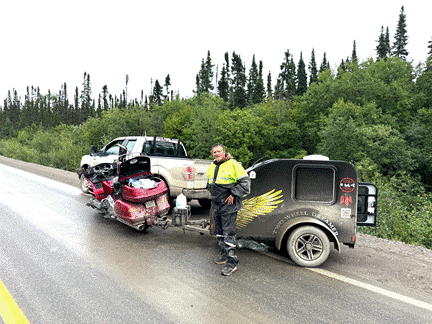
I watched as Claude climbed back into his truck, spun around and disappeared over the hill in the direction he had originally been traveling.
I stood there for a moment and watched until the truck was gone.
Then I looked at the road ahead.
I thanked the good man upstairs for allowing me to survive what had felt like a life-and-death situation.
I climbed back onto my motorcycle.
And headed toward Relais Gabriel.
An hour later, I sat on a worn bench outside a tiny canteen.
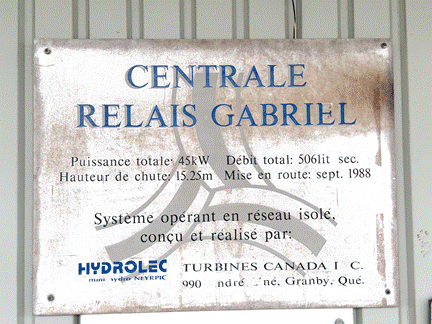
I was exhausted.
My rain gear was streaked and covered with wet soil. My motorcycle and trailer looked as though they had been dragged through a construction site.
A trucker glanced my way.
He looked at me from head to toe.
Then looked again into my eyes.
His eyes seemed to tell the story before he ever opened his mouth.
With English words breaking through his French accent, he made one comment before walking to his truck.
It was only a few words.
But I would carry them with me for the rest of the journey.
He said:
“It appears, for now, that you have survived ‘the road of death.’”
I later learned that Route 389 is also famously nicknamed the Devil’s Road (or la route du diable in French) and sometimes the Highway Through Hell.
I looked back toward the road.
He was right.
But I also knew something else.
I had only completed the first section of the gravel road—approximately 62 miles.
Another 46 miles of unpaved road still lay ahead.
For the moment, though, I was safe.
And sometimes, that’s enough.
If our journeys through life are not adventurous, we may never have a story worth telling.
That day, Route 389 gave me one.
It gave me fear.
It gave me humility.
It gave me a reminder that no amount of preparation can eliminate every risk.
And it gave me Claude.
A stranger whose language I couldn’t speak, but whose actions needed no translation.
I will never forget the road of death.
And I will never forget the man who helped me survive it.
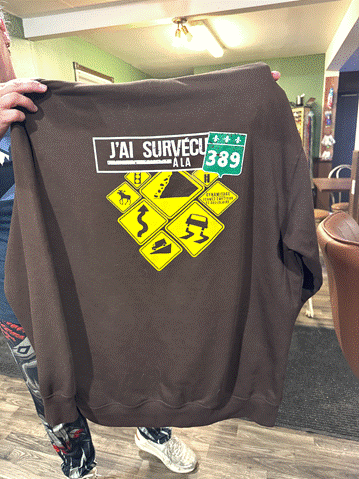
I walked into the canteen at Relais Gabriel. One of the employees was wearing this sweatshirt that was almost absurdly perfect for the occasion. It described my day in a nutshell. Yellow caution signs for curvy roads, steep descents, slippery conditions, moose crossing, fallen rock, blocked roads, blasting in progress – turn off transmitters and mobile phones. There was also a green road sign depicting Route 389.
And, above everything else – the words:
J’ai survécu à la 389
Translation – I survived the 389 (The Road of Death).
And that I did.